

Compare broadband prices
before you renew.
Broadband prices often creep up once your contract ends. Compare your current bill against live UK deals, then see whether switching or staying and renegotiating wins for you.
Taupia is free to use. You stay in control of every action.
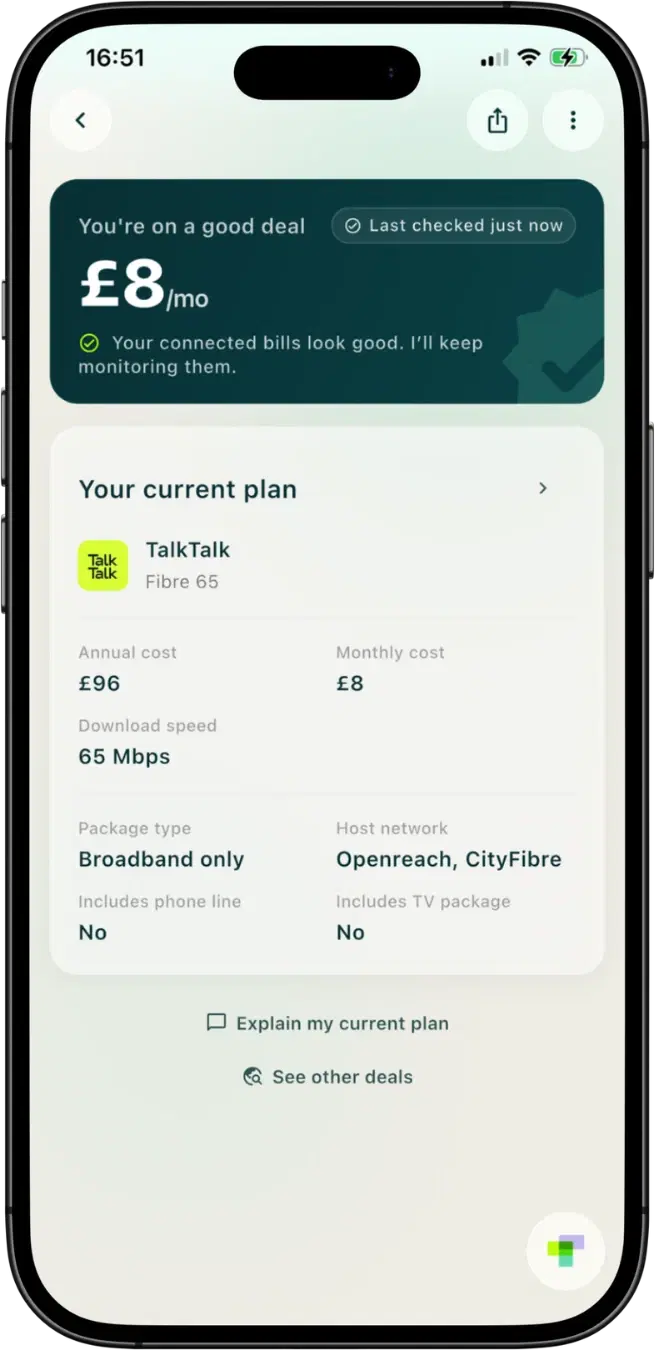
SHORT ANSWER
Broadband costs are shaped by your speed, package, provider, contract length and any out-of-contract or annual price rises. Check your current deal, compare what similar speeds cost, then decide whether to switch, speak to your provider or keep monitoring.
Out-of-contract broadband can cost more than it needs to.
Broadband savings depend on your provider, speed, postcode, bundle, setup fees and contract status. Customers who are out of contract or paying an old standard rate may be able to reduce their annual cost by re-contracting, negotiating or switching.
Check my broadband deal£183
potential annual saving by checking your broadband deal
Use this as an example saving, not a guarantee. Your result depends on your current plan, speed needs, postcode availability, setup fees and whether you are still in contract.
Source: Ofcom pricing research and Taupia broadband savings analysis.
Your broadband bill has three moving parts.
Some change with what your home needs. Others change with the deal you are on. Understanding the difference helps you know what to check.
Your speed
Your speed
The download and upload speed your household needs.
Speed needs change with working from home, streaming, gaming, video calls and the number of people using the connection.
Your package
Your package
What is included in your broadband deal.
Broadband-only, TV bundles, landline, router costs, setup fees and extras can all change the real monthly cost.
Your contract
Your contract
The price, contract length, renewal timing and exit fees you are on.
This is the part worth reviewing regularly, especially when your minimum term ends, prices rise or better options appear.
Your speed
The download and upload speed your household needs.
Speed needs change with working from home, streaming, gaming, video calls and the number of people using the connection.
Your package
What is included in your broadband deal.
Broadband-only, TV bundles, landline, router costs, setup fees and extras can all change the real monthly cost.
Your contract
The price, contract length, renewal timing and exit fees you are on.
This is the part worth reviewing regularly, especially when your minimum term ends, prices rise or better options appear.
Broadband bills can rise when your deal changes.
Many broadband plans start with a lower introductory price, then move to a higher monthly cost when the minimum term ends. Speeds, setup fees, contract length and renewal timing can also make deals harder to compare.
01
Intro pricing ends
01
Intro pricing ends
Many packages start with a lower monthly price, then move to a higher standard rate when the minimum term finishes.
02
Out-of-contract pricing can cost more
02
Out-of-contract pricing can cost more
When your broadband contract ends, you may move onto a higher default rate or lose your introductory discount.
03
Better deals are hard to compare
03
Better deals are hard to compare
Speeds, prices, contract lengths, setup fees and bundled extras can make it difficult to know whether you are still on a good deal. Some prices also depend on where you buy: Uswitch says it secures exclusive broadband and mobile offers for its own customers, so a deal there may not be available direct.
See Uswitch and Taupia side by side04
Missed renewal
04
Missed renewal
Your provider should warn you before your contract ends, but it is easy to miss the message or leave the deal unchanged.
01
Intro pricing ends
Many packages start with a lower monthly price, then move to a higher standard rate when the minimum term finishes.
02
Out-of-contract pricing can cost more
When your broadband contract ends, you may move onto a higher default rate or lose your introductory discount.
03
Better deals are hard to compare
Speeds, prices, contract lengths, setup fees and bundled extras can make it difficult to know whether you are still on a good deal. Some prices also depend on where you buy: Uswitch says it secures exclusive broadband and mobile offers for its own customers, so a deal there may not be available direct.
See Uswitch and Taupia side by side04
Missed renewal
Your provider should warn you before your contract ends, but it is easy to miss the message or leave the deal unchanged.
Source: Ofcom Pricing and Consumer Engagement Report 2026 (February 2026).
The first sign is often a higher monthly payment.
A broadband bill can rise because your promo ended, your contract changed, setup costs were added or your bundle no longer matches what you use. The key is knowing which part changed.
Promo ended
A discounted first-term price has expired, so the monthly cost has moved to a higher standard rate.
Annual price rise
Your provider may increase the monthly price during the contract, but new contracts must show any planned rise upfront in pounds and pence.
Bundle changed
TV, calls, router costs or extra services can change the total amount you pay.
Setup or delivery fees
One-off fees can make a deal look cheaper than it is if you only compare the monthly price.
Out-of-contract pricing
You may be paying more because your minimum term ended and you have not reviewed the deal.
You may not need to switch. But you do need to check.
Start by finding what changed. Then decide whether to switch, speak to your provider or keep monitoring.
01
Check your current deal
01
Check your current deal
Look at your speed, monthly price, contract end date, setup fees and exit fees.
02
Compare similar speeds
02
Compare similar speeds
Check what is available at your postcode and whether equivalent broadband deals offer the same or better speed for less.
03
Speak to your provider
03
Speak to your provider
Use your bill and market options to ask whether they can offer a better rate.
04
Switch if it makes sense
04
Switch if it makes sense
If there is a better deal, switching can help you avoid paying more than needed. Check price, speed, reliability, contract length and setup timing first.
Read the broadband switching guide05
Keep monitoring
05
Keep monitoring
If switching is not worth it today, check again when prices, renewal dates or household needs change.
01
Check your current deal
Look at your speed, monthly price, contract end date, setup fees and exit fees.
02
Compare similar speeds
Check what is available at your postcode and whether equivalent broadband deals offer the same or better speed for less.
03
Speak to your provider
Use your bill and market options to ask whether they can offer a better rate.
04
Switch if it makes sense
If there is a better deal, switching can help you avoid paying more than needed. Check price, speed, reliability, contract length and setup timing first.
Read the broadband switching guide05
Keep monitoring
If switching is not worth it today, check again when prices, renewal dates or household needs change.
What happens after you switch broadband provider?
Your new provider confirms the switch details and usually manages the transfer. Depending on your home and connection type, you may receive a new router, need an engineer visit or wait for an activation date.
01
Switch date confirmed
Your new provider tells you when your broadband service is due to start.
02
Router may arrive
Some deals include a new router or installation kit before activation.
03
Engineer visit may be needed
Some homes need installation, line activation or equipment setup before the service goes live.
04
Old service ends
Your previous provider closes the old contract once the switch is complete.
05
First bill arrives
Check that the monthly price, setup fees and contract details match the deal you chose.
Questions about comparing broadband prices
What is the broadband loyalty tax?
The broadband loyalty tax is the extra amount households often pay after introductory pricing ends. Once you move onto an out-of-contract or standard rate, your bill can rise unless you renegotiate or switch.
Why do broadband bills jump after the first contract?
Many plans start with discounted pricing, then move to a higher standard rate when the initial term ends. If you do not review alternatives before renewal, your monthly bill can rise without any improvement in speed or service.
Do I need to know exact technical specs to compare broadband deals?
No. Taupia is designed to present the key trade-offs in plain language so you can compare confidently without networking expertise.
Can I compare broadband plans if my current contract is not finished?
Yes. You can still compare now to understand your options and timing before making a switch decision.
Does faster broadband always mean better value?
Not always. The best-value plan depends on your household usage pattern, contract terms, and total cost over time.
Can Taupia help with energy and mobile as well?
Yes. Taupia can help you monitor and compare energy, broadband, and mobile contracts in one workflow.
Useful next reads and official references for broadband switching
Use these sources to understand switching process changes, contract timing, and how Taupia approaches broadband switching.
See Taupia's wider monitoring and approval model across household bills.
Benchmark your package against realistic market pricing and usage fit.
Use a clear framework to respond when intro pricing ends.
Understand notice wording before accepting higher monthly costs.
Separate contract drift from add-ons, usage spikes, or billing issues.
- Ofcom broadband switchingOfficial
Official guidance on changing broadband provider and what to expect.
- Ofcom switching overviewOfficial
Overview of UK phone and broadband switching protections and process rules.
Taupia's service-specific guide covering timing, fees, installation, and switch day.
The benchmark assumptions and calculation approach behind Taupia's savings claims.
Check whether your broadband deal still makes sense.
Taupia helps you understand your current bill, compare your options and decide what to do next. Nothing changes without your approval.
Taupia is free to use. Add your first bill, or start from your new address, in minutes.
Available on iOS and Android.


- Taupia is free to use
- Takes minutes to begin
- Bills in one place
- You approve what happens