

Compare mobile plans and
SIM-only prices.
Mobile plans quietly get expensive once a handset is paid off or an old deal rolls on. Compare your plan against live UK SIM-only and contract prices to see what fits better.
Taupia is free to use. You stay in control of every action.
SHORT ANSWER
Mobile costs are shaped by your data allowance, handset payments, contract length, roaming needs, network coverage and any planned price rises. Check what you use, compare similar plans, then decide whether to switch, speak to your provider or keep monitoring.
A mobile plan can become poor value when your usage changes.
Mobile savings depend on your data use, handset payments, contract status, roaming needs, network coverage and extras. The biggest opportunities often come from moving to SIM-only after a handset is paid off, reducing unused data, removing extras or switching to a plan that better matches your usage.
Check my mobile plan£304
potential annual saving by checking your mobile plan
Use this as an example saving, not a guarantee. Your result depends on your handset payments, data use, roaming, coverage needs, add-ons and whether you are still in contract.
Source: Taupia mobile savings analysis.
Your mobile bill has three moving parts.
Some change with how you use your phone. Others change with the deal you are on. Understanding the difference helps you know what to check.
Your usage
Your usage
How much data, calls, texts and roaming your household actually uses.
Usage is the starting point because mobile comparison is not only about headline price. Coverage, roaming, data needs and household habits all affect what good value looks like.
Your plan
Your plan
The allowance, network, speed, roaming rules and extras included in your deal.
A plan can look cheap but still be poor value if the allowance, network coverage, roaming terms or add-ons do not fit how you actually use your phone.
Your contract
Your contract
The price, contract length, handset payments, renewal timing and exit fees you are on.
Contract status matters because handset cost, minimum term, exit fees and renewal timing can change whether switching, negotiating or waiting is the better move.
Your usage
How much data, calls, texts and roaming your household actually uses.
Usage is the starting point because mobile comparison is not only about headline price. Coverage, roaming, data needs and household habits all affect what good value looks like.
Your plan
The allowance, network, speed, roaming rules and extras included in your deal.
A plan can look cheap but still be poor value if the allowance, network coverage, roaming terms or add-ons do not fit how you actually use your phone.
Your contract
The price, contract length, handset payments, renewal timing and exit fees you are on.
Contract status matters because handset cost, minimum term, exit fees and renewal timing can change whether switching, negotiating or waiting is the better move.
Mobile bills can drift upward when your plan no longer fits.
Many customers stay on plans that no longer match their usage. Without regular review, you may keep paying for allowances, extras or handset costs that no longer fit how you use your phone.
01
Old plans can become poor value
01
Old plans can become poor value
A plan that was suitable last year may now be overpriced compared with newer offers for similar usage.
02
Allowance mismatch wastes money
02
Allowance mismatch wastes money
Many people pay for far more data than they use, or pay penalties because allowances no longer match real behaviour.
03
Renewal timing gets missed
03
Renewal timing gets missed
Your provider should warn you before your contract ends, but it is easy to miss the message or leave the plan unchanged.
01
Old plans can become poor value
A plan that was suitable last year may now be overpriced compared with newer offers for similar usage.
02
Allowance mismatch wastes money
Many people pay for far more data than they use, or pay penalties because allowances no longer match real behaviour.
03
Renewal timing gets missed
Your provider should warn you before your contract ends, but it is easy to miss the message or leave the plan unchanged.
The first sign is often a monthly cost that no longer matches your usage.
A mobile bill can feel too high because your data needs changed, your handset cost is still bundled in, your promo ended, roaming was added or your contract moved past its minimum term.
Too much data
You may be paying for an allowance you rarely use.
Too little data
You may be paying add-ons or penalties because your allowance is too low.
Handset cost hidden
Some contracts include the phone cost, so compare SIM-only options once the handset is paid off.
Roaming or extras
Roaming, international calls, insurance or entertainment add-ons can increase the total cost.
Price rise applied
Your provider may increase the monthly price during the contract, but new contracts must show any planned rise upfront in pounds and pence.
Source: Ofcom rules from 17 January 2025 ban inflation-linked or percentage-based price-rise terms in new phone, broadband and pay-TV contracts.
You may not need to switch. But you do need to check.
Start by finding what changed. Then decide whether to switch, speak to your provider or keep monitoring.
01
Check your current plan
01
Check your current plan
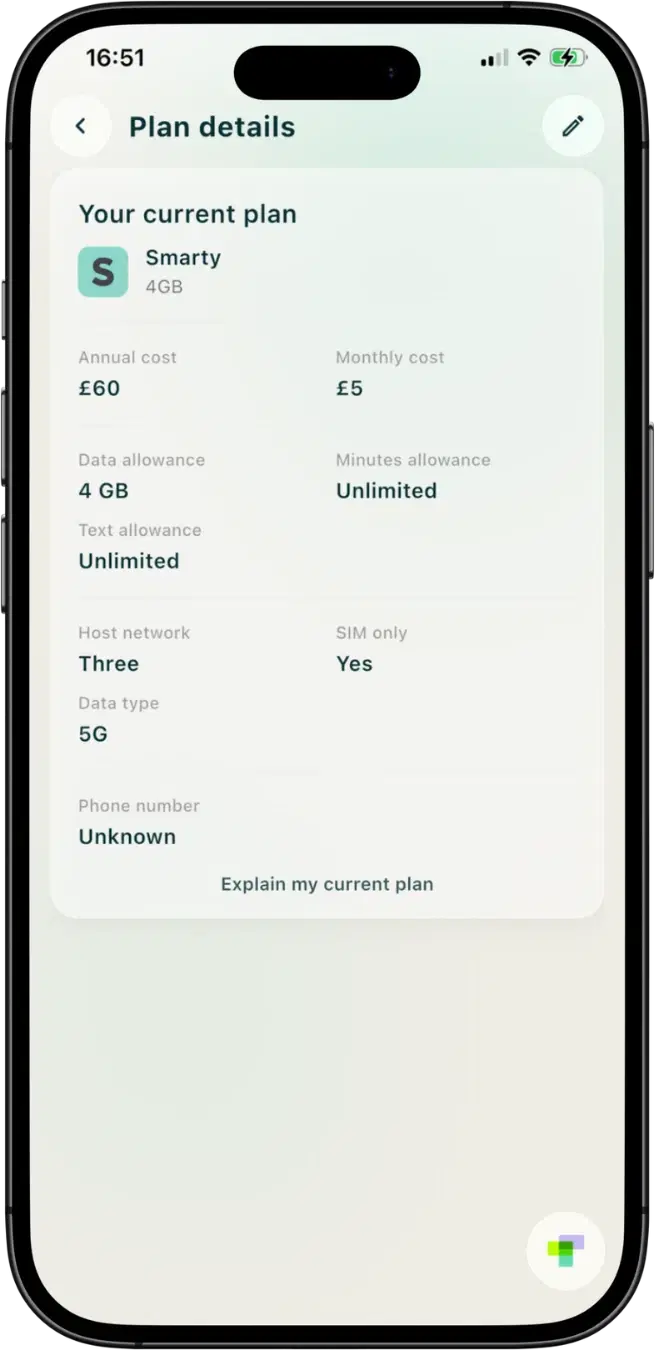
Look at your monthly price, data use, contract end date, handset payments, roaming rules and exit fees.
02
Compare similar usage
02
Compare similar usage
See whether equivalent mobile plans offer the same data, coverage and features for less. Comparison sites cover mobile too, and some add a guarantee on top: MoneySuperMarket's price promise covers mobile phone deals, though not energy. Taupia shows the full list, then names the plan it would pick and why.
See MoneySuperMarket and Taupia side by side03
Check network coverage
03
Check network coverage
A cheaper plan is not useful if coverage is poor where you live, work or travel.
04
Speak to your provider
04
Speak to your provider
Use your usage and market options to ask whether they can offer a better rate.
05
Switch if it makes sense
05
Switch if it makes sense
If there is a better plan, switching can help you avoid paying more than needed.
Read the mobile switching guide06
Keep monitoring
06
Keep monitoring
If switching is not worth it today, check again when usage, renewal dates or prices change.
01
Check your current plan
Look at your monthly price, data use, contract end date, handset payments, roaming rules and exit fees.
02
Compare similar usage
See whether equivalent mobile plans offer the same data, coverage and features for less. Comparison sites cover mobile too, and some add a guarantee on top: MoneySuperMarket's price promise covers mobile phone deals, though not energy. Taupia shows the full list, then names the plan it would pick and why.
See MoneySuperMarket and Taupia side by side03
Check network coverage
A cheaper plan is not useful if coverage is poor where you live, work or travel.
04
Speak to your provider
Use your usage and market options to ask whether they can offer a better rate.
05
Switch if it makes sense
If there is a better plan, switching can help you avoid paying more than needed.
Read the mobile switching guide06
Keep monitoring
If switching is not worth it today, check again when usage, renewal dates or prices change.
What happens once you move to a new mobile plan
Taupia keeps post-switch milestones clear so the transition stays predictable and low-friction.
01
Choose whether to keep your number
If you want to keep your number, request a PAC. If you do not, request a STAC.
02
Switch details confirmed
Your provider confirms the transfer, activation or plan-change timing.
03
SIM or eSIM may be needed
You may receive a new SIM, activate an eSIM or update your plan in-app.
04
New allowance starts
Your data, calls, texts, roaming and contract details move to the new plan.
05
First bill arrives
Check that the monthly price, allowance, add-ons and contract details match the plan you chose.
Questions about comparing mobile prices
Why do mobile plans become poor value?
A plan can stop fitting when your data use changes, your handset is paid off, a promotion ends, roaming rules change or your minimum term passes without review.
How can I reduce overpaying on mobile?
Start from your real usage, coverage needs and contract timing, then compare similar alternatives before renewing or switching.
Is SIM-only always the cheapest option?
Often, but not always. The right choice depends on your device needs, usage profile, and the full contract cost.
Can I compare plans before my contract ends?
Yes. Comparing early helps you understand options and switch timing before renewal pricing takes over.
How do I avoid paying for unused data?
Start with your typical usage pattern and compare plans that match it, rather than defaulting to the highest allowance tiers.
Can Taupia help with energy and broadband too?
Yes. Taupia supports comparison and switching workflows across energy, broadband, and mobile.
Useful next reads and official references for mobile plan decisions
Use these sources to understand mobile switching rules, number transfers, and how Taupia approaches mobile comparisons.
See Taupia's broader comparison and approval workflow across bill categories.
Check whether your allowance, contract, or handset setup is costing too much.
Review PAC timing, handset status, and renewal options before committing.
Decode mobile price-increase notices and choose the right response.
Troubleshoot overage, roaming, and contract-driven mobile bill spikes.
- Ofcom mobile switchingOfficial
Official guidance on changing mobile provider while keeping your number if needed.
- Ofcom switching overviewOfficial
Overview of UK consumer switching rights and provider responsibilities.
Taupia's service-specific guide covering transfer timing, PACs, and contract checks.
The benchmark assumptions and calculation approach behind Taupia's savings claims.
Choose a mobile plan that fits your real usage
Compare clearly, avoid oversized plans, and switch when the value is strong.
Taupia is free to use. Add your first bill, or start from your new address, in minutes.
Available on iOS and Android.


- Taupia is free to use
- Takes minutes to begin
- Bills in one place
- You approve what happens