
British Gas
Fixed
Cap Tracker Mar28 v1
Key features: Paperless billing - optional
Annual bill
£1,613.32
≈ £134/mo


Understand what drives your bill, why it can rise, and what to check before you switch, negotiate or keep monitoring.
Taupia is free to use. You stay in control of every action.
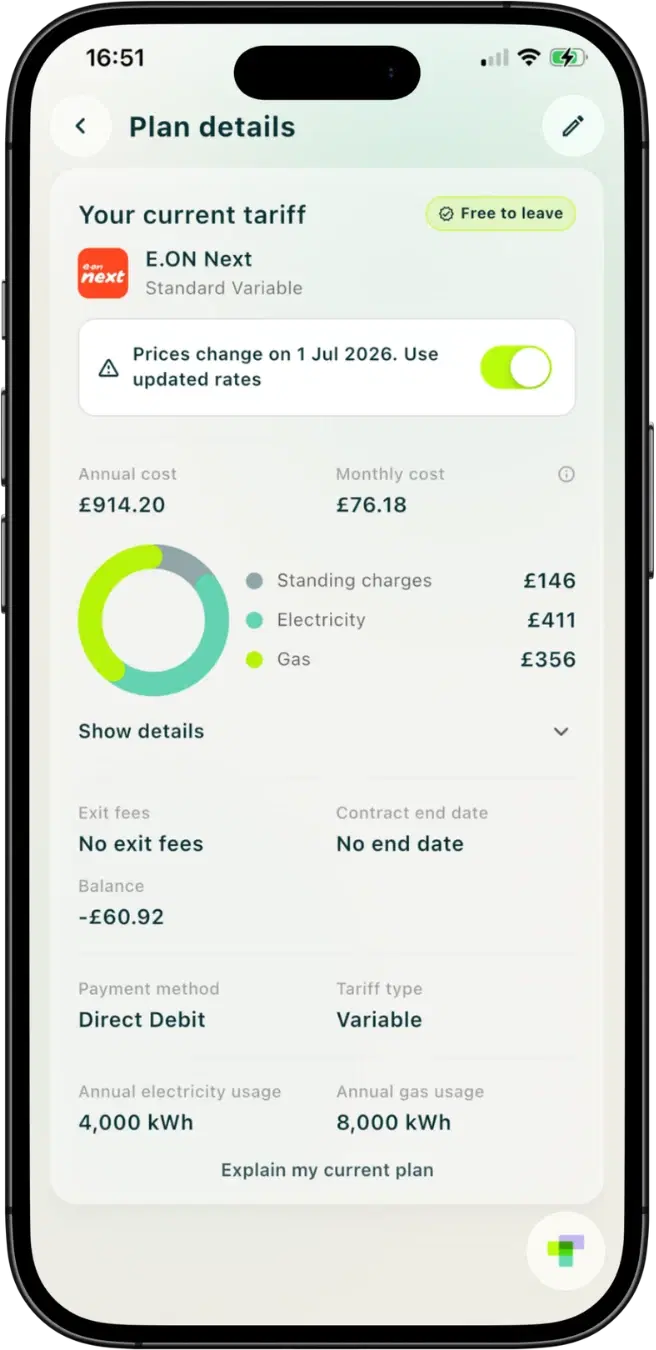
Energy bills are shaped by usage, rates and your tariff. A bill can rise when you use more energy, your rates change, standing charges increase, or your supplier estimates your usage. Check your tariff, compare the market, then decide whether to switch, speak to your supplier or keep monitoring.
Energy savings depend on your tariff, usage, region, payment method and whether you are on a fixed or variable deal. Some households can save more than £200 a year by shopping around for a cheaper fixed tariff, especially when market prices move below the default tariff cap.
Check my current tariff£260
potential annual saving for an average household
Use this as an example saving, not a guarantee. Your result depends on your current tariff, usage and available deals.
Source: Ofgem and Taupia savings analysis.
Some change with how you use energy. Others change with the deal you are on. Understanding the difference helps you know what to check.
How much gas and electricity your home uses.
Usage changes with your home, habits, season and appliances. It affects your bill, but it is not always the fastest thing to change.
What you pay per unit of energy, plus standing charges.
Your tariff sets these rates. If rates change, your bill can rise even when your usage stays similar.
The tariff, contract length, exit fees and renewal timing you are on.
This is the part worth reviewing regularly, especially when your tariff ends, prices rise or better options appear.
How much gas and electricity your home uses.
Usage changes with your home, habits, season and appliances. It affects your bill, but it is not always the fastest thing to change.
What you pay per unit of energy, plus standing charges.
Your tariff sets these rates. If rates change, your bill can rise even when your usage stays similar.
The tariff, contract length, exit fees and renewal timing you are on.
This is the part worth reviewing regularly, especially when your tariff ends, prices rise or better options appear.
Taupia agents keep scanning available energy tariffs and ranking the options that could reduce bills. This preview shows a dual-fuel average-household view before your own bill, usage and address refine the result.
Our agents keep checking the market so users can be alerted when a stronger fixed, tracker or non-SVT option appears.
16 non-fixed tariffs hidden
Only fixed tariffs are shown by default — these lock your unit rates for the contract term. Switch this off to include every tariff in the scan.
Average-household view. These examples use average dual-fuel consumption. Your best tariff can change with postcode, region, meter type, standing charges, unit rates and your real kWh usage.
Cap Tracker Mar28 v1
Key features: Paperless billing - optional
Annual bill
£1,613.32
≈ £134/mo

Fix'd Dual Sep26 24M v1 - Family Advantage+
Key features: Paperless billing - mandatory · Online account management
Annual bill
£1,640.49
≈ £137/mo
Fix'd Dual Sep26 18M v1 - Family Advantage+
Key features: Paperless billing - mandatory · Online account management
Annual bill
£1,640.59
≈ £137/mo

Sainsburys Fix and Reward Fixed 24m v51
Key features: Paperless billing - mandatory
Annual bill
£1,686.16
≈ £141/mo

Octopus 18M Fixed September 2026 v2
Key features: Paperless billing - mandatory · Online account management
Annual bill
£1,699.00
≈ £142/mo
Estimated annual bills are indicative and based on an average household benchmark. Actual costs depend on your usage, region, meter type, payment method, standing charges and unit rates.
A fixed deal can end. Variable prices can rise. Better options can appear. These are the moments worth checking.
01
Your protected rate expires, and you may move onto a more expensive default tariff.
02
If you are not fixed, your rates can rise when market prices or price caps change.
03
A similar tariff may become cheaper, but most people are not checking every week.
04
One missed supplier email can leave you on a deal that no longer suits you.
Open the renewal email action plan01
Your protected rate expires, and you may move onto a more expensive default tariff.
02
If you are not fixed, your rates can rise when market prices or price caps change.
03
A similar tariff may become cheaper, but most people are not checking every week.
04
One missed supplier email can leave you on a deal that no longer suits you.
Open the renewal email action planA bill spike can come from usage, tariff changes, standing charges, estimates or billing catch-up. The key is knowing which part changed.
Cold weather, working from home or new appliances can increase consumption.
Your tariff rate can change, especially if you are on a variable tariff.
Fixed daily charges can increase even if your usage stays steady.
Supplier estimates can make a bill look wrong or unexpectedly high.
If previous bills were estimated too low, a later bill may include the difference.
Start by finding what changed. Then decide whether to switch, speak to your supplier or keep monitoring.
01
Look at your unit rates, standing charges, tariff type, exit fees and end date.
02
See whether similar deals are available for less. A comparison site builds its energy quote from a usage figure you type in, and Uswitch's own guide says estimates are fine, so the ranking moves with the estimate. Taupia reads the kWh off your last bill instead.
See Uswitch and Taupia side by side03
Use your bill and market options to ask whether they can offer a better rate.
04
If there is a better deal, switching can help you avoid paying more than needed.
05
If switching is not worth it today, check again when prices, renewals or usage change.
01
Look at your unit rates, standing charges, tariff type, exit fees and end date.
02
See whether similar deals are available for less. A comparison site builds its energy quote from a usage figure you type in, and Uswitch's own guide says estimates are fine, so the ranking moves with the estimate. Taupia reads the kWh off your last bill instead.
See Uswitch and Taupia side by side03
Use your bill and market options to ask whether they can offer a better rate.
04
If there is a better deal, switching can help you avoid paying more than needed.
05
If switching is not worth it today, check again when prices, renewals or usage change.
You will not lose your gas or electricity. Your supply continues as normal while your old and new suppliers handle the transfer.
01
Your gas and electricity are not disconnected during the switch.
02
Your new supplier tells you when your new tariff starts.
03
Opening and closing readings help keep bills accurate.
04
Your previous supplier sends a final bill or refund.
05
Your new provider bills you on the agreed rate and payment terms.
ENERGY MARKET UPDATE
Price caps, supplier rate changes and tariff updates can change what you pay. Use this update to understand what changed and whether your current tariff is worth checking.
Ofgem confirmed the October to December 2026 cap on 26 August 2026, and it applies from 1 October. On equivalent consumption, annual bills rise from £1,862 to £1,935 (+£73/year, or 3.9%) on the like-for-like basis, or from £1,663 to £1,723 on Ofgem's own current basis. Most of that is gas: gas bills rise about 8%, while homes with no gas see under 1%. Ofgem confirms the January to March 2027 level on 25 November 2026. If you are on a variable tariff, it is worth comparing now.
Often, it is worth checking. If your tariff moved to an SVT, compare your unit rate and standing charge against current fixed options so you can see whether your new default price is still competitive.
An SVT is the supplier's default tariff after your fixed term ends or when no new deal is chosen. Prices can change, and the rate is commonly above competitive fixed offers.
Start with your current bill, not generic quotes. Compare unit rates, standing charges, and contract terms against live options. This shows whether switching now or waiting is the better move.
Check the new proposed tariff against current market options before accepting. A fast comparison usually tells you within minutes whether renewing would mean overpaying.
No. Your energy supply is never interrupted. The same pipes and wires deliver your energy regardless of who supplies it. Switching is an administrative change, and your lights stay on throughout.
Yes. Compare at any point, including mid-contract. Check your current deal's exit fees against the potential saving to decide whether to switch now or wait until the fee window closes.
Switching takes up to 5 working days. Taupia handles cancellation, new registration, and meter reading handover. You approve the switch and Taupia does the rest.
Yes. Smart meters work with major Great Britain suppliers. In rare cases, a first-generation smart meter may temporarily lose smart functionality after switching until the new supplier activates it remotely.
Taupia's energy comparison and switching journey is available across Great Britain: England, Scotland, and Wales.
Yes. Once the bill is in your name, you can compare immediately. This is useful for first-time renters and people who have just moved home.
Traditional comparison tools are usually one-off journeys. Taupia is designed to keep managing your bills after the first switch so you do not have to restart from scratch every time.
| Feature | Taupia | Traditional tools |
|---|---|---|
| Ongoing bill management | Continuous monitoring over time | One-time comparison journey |
| Contract and renewal tracking | Automatic reminders before contracts end | Requires manual re-check |
| Personalised bill insights | Guidance based on your actual bill | Generic FAQs and help pages |
| Household overview | Combined monthly view across all bills | Separate journeys, no unified view |
| Switching | You approve it inside the app | Redirect to provider website |
| After switching | Monitoring continues automatically | Journey ends after switch |
Taupia handles energy, broadband, and mobile from one account. The loyalty tax pattern is similar across all three.
When you approve an energy switch through Taupia, the new provider pays a referral commission after it completes. Taupia retains that commission to keep the core product free.
Use these routes when your contract is ending, your renewal email arrives, or you are setting up bills at a new home.
Main page for tariff checks, overpaying checks, and switching decisions.
Get direct answers on savings, timing, fees, smart meters, and switching steps.
Work through your tariff type, when any fix ends, and the exit fee for a verdict.
Use this focused check when you want a quick yes/no on tariff value.
Follow a short sequence before accepting any renewal offer.
Start here if you have just moved and need to set up bills in the right order.
The main guide to setting up bills when renting: what each bill is and what drives its price.
Use a step-by-step setup order for council tax, water, energy, and broadband.
Stage-based admin guide for fixed location-linked bills.
Decode increase notices and choose switch vs renegotiate with less guesswork.
Diagnose sudden bill jumps before taking action.
Official regulator guidance for households comparing and managing energy supply.
Independent guidance on tariff types, standing charges, and what to compare.
The benchmark assumptions and calculation approach behind Taupia's savings claims.
Upload your bill, check if you are overpaying, and get a clear next step for switching or waiting.
Taupia is free to use. Add your first bill, or start from your new address, in minutes.
Available on iOS and Android.